(Scroll down for Thomas Paine In New York photos)
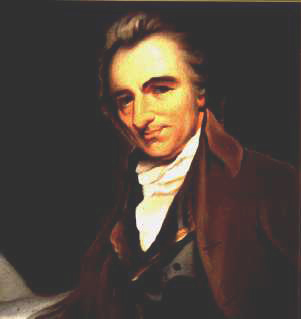
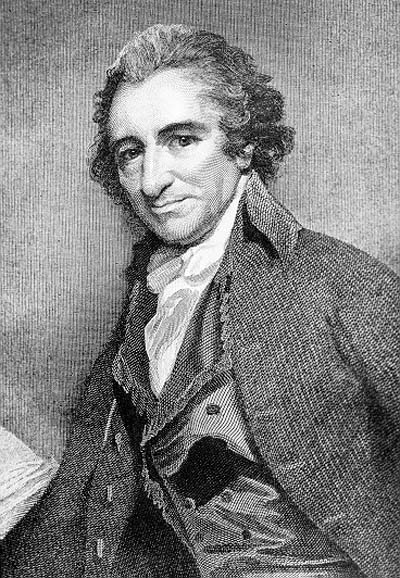
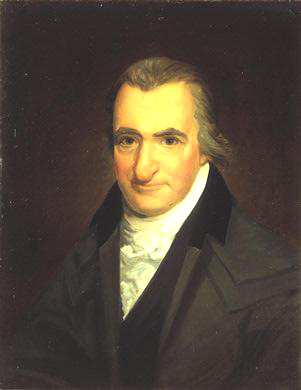
- Arrived in Philadelphia on November 30, 1774 with letters of recommendation from Benjamin Franklin. Soon after, became editor of The Pennsylvania Magazine.
- Published African Slavery in America in 1775 criticizing slavery as unjust and inhumane. Paine was a strong abolitionist almost 100 years before the end of slavery and was one of only two founding fathers to have never owned slaves - the other being John Adams.
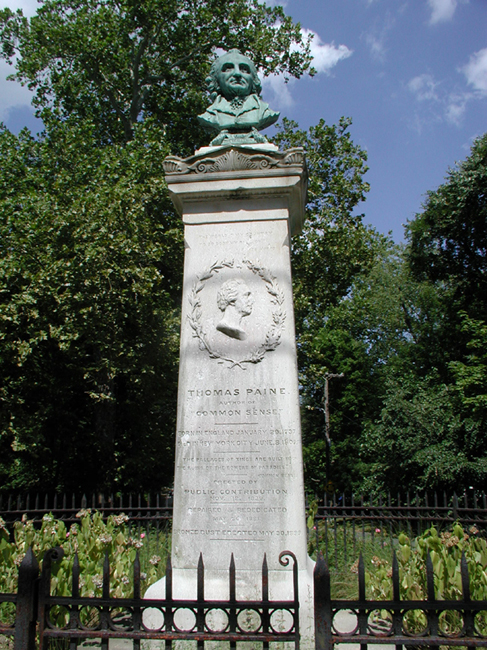
- January 10, 1776 published Common Sense. Sold 500,000 copies to a population of roughly three million. Refused royalties for his writings which would have made him wealthy. He did not believe he should profit from the cause of liberty. This publication is credited with not only being the motivating factor in bringing the colonies to revolution, but also with being the inspiration for Thomas Jefferson in writing The Declaration of Independence. Some historians speculate that certain parts of The Declaration of Independence were actually ghostwritten by Thomas Paine.
- From 1776 to 1780 he held various positions including Aide-de-Camp to General Greene in the Continental Army, Secretary to the Committee for Foreign Affairs, and Clerk to the Pennsylvania Assembly.
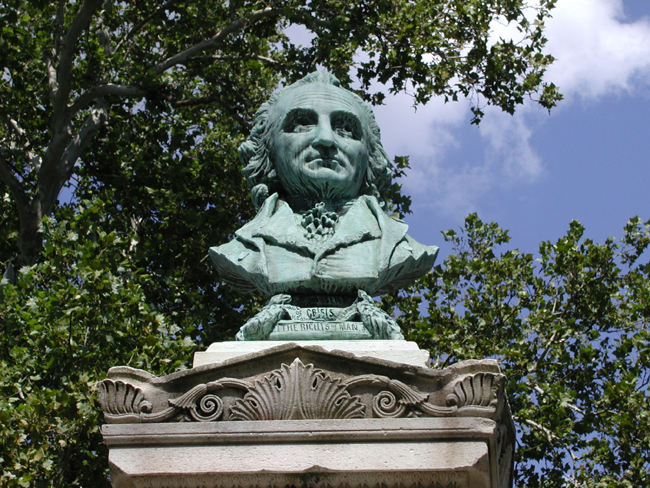
- Published The Crisis papers between 1776 and 1783. On Christmas Day 1776, George Washington read the first essay to his dispirited soldiers to boost morale. Shortly afterward the energized soldiers - emboldened by Paine's words - launched a surprise attack on unsuspecting Hessians and won the decisive battle of Trenton.
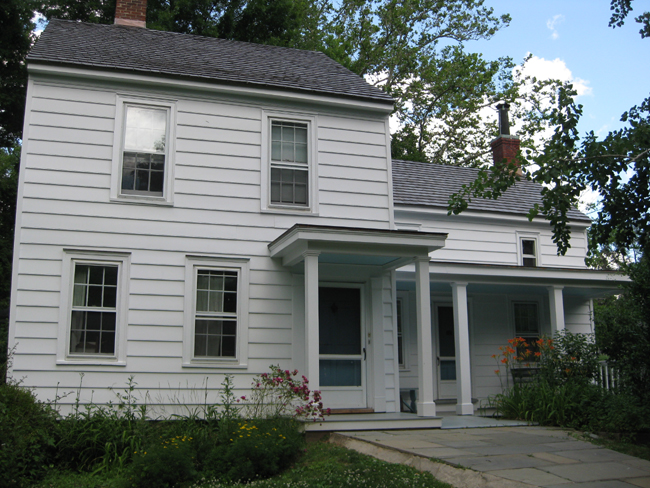
- Much of Paine's service to America had been at his own expense. Acknowledging this, in 1784 New York State gave him a confiscated Royalist farm in New Rochelle, and in 1785 Congress awarded him $3000.
- Returned to England in 1787 to raise funds for the building of a 500 foot single span iron bridge he designed.
- Between March 1791 and February 1792 published Rights of Man, a treatise on human rights defending the French Revolution and condemning aristocracy. After publication, Paine is considered a traitor in England and leaves for France (avoiding being hanged) where he had recently been granted citizenship and elected to the National Convention. Later in England, he is tried in absentia and convicted of seditious libel.
- Due to his vote against the execution of King Louis XVI, stemming from his opposition to capital punishment, Paine is imprisoned in December of 1793, during France's Reign of Terror. He is released ten months later.
- The Age of Reason is published in 1794. While imprisoned within earshot of the guillotine, Paine began Part II of The Age of Reason. This publication emphasizes Paine's belief in God while at the same time condemning the Bible, Christianity and religion in general. The idea of God as the Creator of the Universe as evidenced by science and nature is put forth while atheism is denounced. Regardless, as a result of The Age of Reason Paine is branded an atheist in the United States and shunned upon his return.
- During imprisonment in Luxembourg he narrowly escaped execution. Common practice in this age was for a jailer to walk down the prison corridors with a piece of charcoal in hand. When approaching the cell door of a man scheduled to be beheaded, a mark was placed on that door to alert guards as to who should be taken to the guillotine the following morning. 168 doors were marked one day, including Thomas Paine's. But since a doctor had been visiting Paine at the time, his cell door was left open and flush against the outer wall. When the jailer passed by, he marked the wrong side of the door. Once the door was closed, the mark was now on the inside of the cell, thereby sparing Paine's life.
- Agrarian Justice published in 1797. Paine argued that poverty is a construct of 'civilized life' and not a facet of the natural world. The earth is 'the common property of the human race' while cultivated, landed property is a necessary evil. To rectify this imbalance he proposed a 'national fund' giving every person upon reaching 21 years of age a fixed sum of £15, and £10 annually upon reaching 50 years. This would be paid for through an estate tax.
- Returned to America in 1802 after an invitation from President Thomas Jefferson.
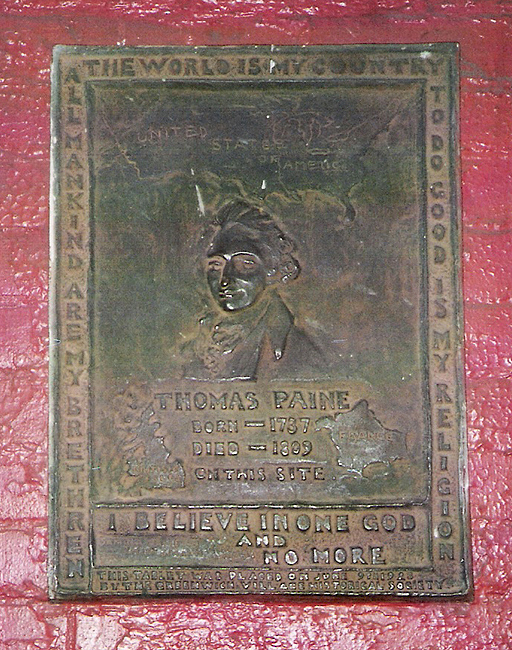
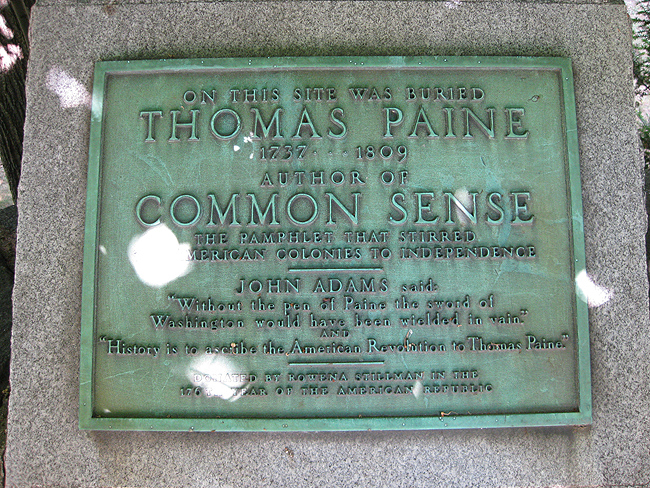
- Died in New York City on June 8, 1809, on what is now 59 Grove Street in Greenwich Village. There were reportedly only six mourners who attended the funeral procession to Paine's farm in New Rochelle, two of them being freed slaves.
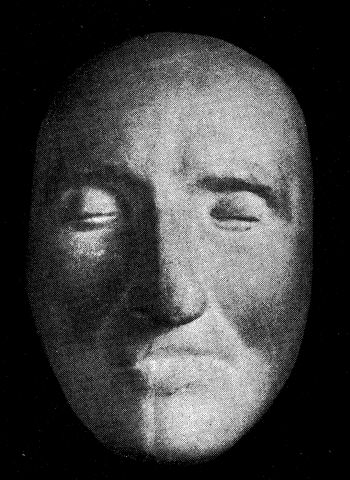
- Artist and friend John Wesley Jarvis created a plaster death mask of Paine before burial. Although the nose on the mask was bent to one side, Paine's actual nose was not. This imperfection in the mask was a result of the plaster not being dry before removal and the weight of the mold caused a leaning of the structure.
- In September 1819, William Cobbett went to Thomas Paine's grave in New Rochelle, dug up Paine's body, and raced the authorities to the docks where he sailed back to England with the corpse. Upon revealing the body to Customs agents in Liverpool, Cobbett announced "There, gentlemen, are the mortal remains of the immortal Thomas Paine." Cobbett's intention was to build a memorial to Paine in England since his memory (and his grave) was being disrespected in the United States. There was just one problem - Paine had been strongly against the monarchy and was still considered something of an outlaw in England. Cobbett's plans were refused. And so, what was left of Thomas Paine was stored in William Cobbett's attic and remained there until his death.
- In 1822 William Cobbett had a 'grave mask' made from Paine's decomposed body. This mask (along with the death mask) is on display at the Thomas Paine National Museum and will be useful in positively matching Paine's skull (now believed to be in Australia) with the mold taken from the grave mask.
- After William Cobbett died in 1835, it is believed his son sold the remains of Thomas Paine in pieces. At one time, a Bishop in England was said to have Paine's right hand and skull adorning his mantlepiece. An English woman claimed to have his jawbone. A man in France claimed to own one of his ribs. Buttons are also said to have been made from his bones. How ironic that this first 'citizen of the world' would end up scattered around it. Efforts are underway to have Paine's remains returned to New Rochelle for re-burial.
-- Joel Barlow (Wrongly attributed to John Adams)
-- Robert Green Ingersoll
-- Thomas Edison
-- Carl Sagan